While many production companies have been able to build up a successful business with after-sales services in recent years, the increasing digitalization of these areas presents the organization with new challenges. -Guest article by Dr. des. Philip Osterrieder
Teaching machines to read, send and process data and the corresponding software programming is only half the battle on the way to becoming a successful provider of digital services. There are also a number of economic, strategic and organizational questions to which meaningful answers must be found: How must an organization be structured in order to optimally design the development, distribution and provision of digital services? Which employees and project teams do I assign to this?
Strategic considerations are taken into account too late
Such a development is often seen in production companies: First, investments are made in the expansion of the digital service business with a focus on technical implementation (IT infrastructure, software, etc.). This is followed by planning the economic framework conditions in the form of designing the business model, developing a sales approach and more. It is often only after this that strategic considerations are discussed as to which digital service makes sense for which customer, when and how. The next step is to (re)structure the service organization to increase the effectiveness of sales and the provision of digital services.
After all, it has now been established that the strategic examination of the digital service business should ideally take place before the technical development. However, the question of the ideal form of a service organization cannot yet be answered conclusively.
Most companies have a separate service department
Due to various influencing factors (e.g. support of the service culture, incompatibility of service and product business, different sales approaches), it has so far proven successful to separate the service organization as an independent unit. This is why this approach prevails in the organizational charts of most manufacturing companies. The advent of digital services, on the other hand, makes a clear separation of the service organization much more difficult. This is because the development of new digital services requires product and service developers to work together alongside IT experts and product managers, as both sides (product and service) often only achieve the desired value for customers in symbiosis.
The ideal procedure must always be sought for each individual case
This raises the question for production companies of how they need to structure their digital service business in order to be successful and profitable in the long term. Basically, most organizational researchers agree on this: the structures in individual companies are too specific to make general statements here. Very different approaches can lead to optimal results. However, this also makes it difficult to develop a guideline that companies can follow in the organizational process.
Guidelines for structuring an efficient service organization
In addition to all the differences, there are also a few similarities between production companies, so that we can still make statements about how the offering and provision of digital services can be successfully implemented. This is because successful companies often reveal a very similar approach to the integration of digital service activities. The different activities can be divided into three core processes: Service development, sales and provision.
In principle, each core process can be structured individually and be less or more separated from the product business. There are various options for production companies as to how these digital service activities can be integrated. The following three questions and the underlying flowchart can be helpful in the decision-making process:
1. how do we generally deal with new topics?
Is there a new technology, methodology or supplier? In such a case, who is typically tasked with the integration or implementation into the company's own structure? It is usually advisable to assign a group of people who are closest to the topic in their daily work. In the case of a digital service, for example, this could be the IT department or the After-Sales be. In terms of the division into the three core processes, development would probably be in the technical area, while sales would be anchored in the after-sales department. However, it is also possible to set up an extra project team for new topics that is integrated independently into the organization.
2. how different is the targeted digital service business from previous activities?
In some cases, the business model or sales approach may not differ too much because, for example, the company has been offering software solutions for some time. In most cases, however, this type of software development and service provision is completely new territory for the organization. In this case, it is advisable to integrate similar activities more closely and to tend to separate different ones.
3. how do we usually interact with our customers?
With this in mind, we ask ourselves to what extent sales can, may and should operate independently of the product business. The sale of services is fundamentally different from the sale of primary products. Many companies therefore take the option of setting up a separate sales team for this area and defining new positions such as sales consultants. However, if the company relies on a "one-face-to-customer" principle, it is important to integrate service and product sales.
Flowchart of the organizational structure
Based on the three key questions, the following flowchart can help you define and develop the right organizational form for setting up and expanding your digital services business. The flowchart will help you to decide whether you should carry out the development, sales and provision of digital services in a dedicated organizational unit or whether it would be better to integrate the individual areas into existing structures in your company.

An aid and not a patent remedy
Production companies have various options for organizing their digital service business and leading it to success. A sensible path can be found with the above questions and the flowchart above. However, this approach is no substitute for an in-depth analysis and discussion of a possible structure. However, it can be consulted here for support and discussed in the organizational phase, which is essential in order to be successful in the long term.
Examples of functioning organizational forms
There are few general statements that can be made about how a production company should position itself structurally in order to be successful with digital services. The focus in service is increasingly shifting to Remote approaches or innovative maintenance strategies such as Predictive maintenance. This results in completely new requirements for companies.
As diverse as organizational structures have to be, there are a number of valid structures that are successful in practice. It can be helpful to take a closer look at these examples in order to find your own ideal line in the restructuring process.
Just as you show your hairdresser a photo of a suitable haircut to hopefully end up with similar hair, you can also benefit from the success stories of others in the case of digital services. Another example of this approach is the development of new business models based on the 60 patterns of the St. Gallen Business Model Navigators.
The typology presented below uses the same principle. It shows organizational options in an abstract form. The 8 types are based on the three basic organizational forms (divisional, functional, matrix) and are the result of a scientific study that incorporated information from over 80 companies and several expert interviews.
1st Hub & Spoke
is a very popular variant in which companies establish a separate digital unit that takes care of the technological research and development of new methods (e.g. machine learning). This supports the technological area of responsibility in the development of digital services as a "contractor" for the service teams. The service teams are located close to the product and market within the individual divisions. The biggest problem with this form is the avoidance of redundancy and the distribution of resources.

2. front-end convergence
Front-end convergence is particularly useful for product-based company structures that have a strong sales organization. In principle, the sales organization has all possible options in business processing at its disposal and can choose between product, software, service or other offerings. With this model, it is often difficult to Train sales staff sufficiently to ensure that digital services are not neglected.

3. top loading
Top loading is used for faster (market-side) development of digital services. This staff unit format is often chosen by companies with a central concentration of decision-making. Important aspects can be discussed promptly with those responsible, but acceptance by departments outside the staff unit can be problematic.

4. breaking up
This type corresponds to the closest relative of a separate service organization. Separation can take place at different levels: divisional, departmental or team level. In addition to the obvious advantage of better control (P&L responsibility), one of the biggest problems is the cross-functional coordination between service and product, especially if both offerings address the same customer segment.

5. zipper organization
In most cases, a project organization in which project members with clear powers and responsibilities from different areas come together is suitable for starting to consider the potential of introducing digital services. The fast and resource-saving implementation of this type is attractive, but sustainable continuation must be considered early on. Accordingly, in most cases this type only makes sense as an interim solution.

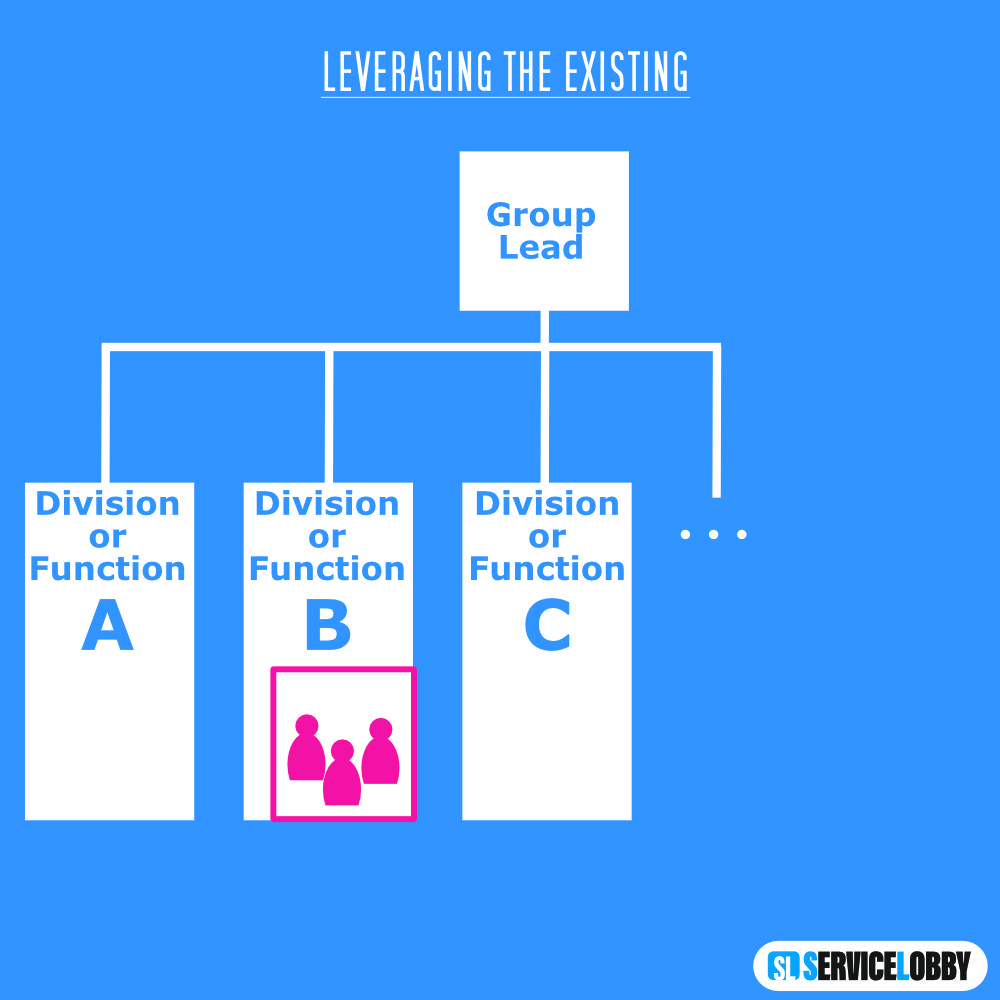
6 Leveraging the Existing
This variant corresponds to the complete integration of digital service activities by assigning the new tasks to existing people and teams. Prioritizing tasks and managing digital service activities are clear weaknesses in this case, for which companies must find a solution if they choose this path.
7. market rationale
This is a common type in which strongly market-oriented companies establish teams for the development of digital services close to the product or market. This is often the result of very different market, product or customer requirements that make a high degree of specialization necessary. The alignment between the divisions with regard to standards (platforms, interfaces, service portfolio, etc.) requires great attention here.

8. service nexus
This form describes the only representative of a matrix organization. In principle, some of the problems of other types, such as the definition of standards and control, could be solved here. In practice, however, this solution is often very slow and politically demanding due to the high level of coordination required within the extensive overhead.

Among other things, the service strategy influences the applicability of individual types
While the typology could only be presented briefly here to show responsible managers that there are a number of successfully implemented forms that they can fall back on in the restructuring process, a detailed discussion is necessary. Each type has further advantages and disadvantages, as well as certain characteristics that may or may not be compatible with your company's chosen service strategy right from the start. This must be taken into account when applying the typology.
About the author:

Dr. des. Philip Osterrieder received his doctorate from the University of St.Gallen in 2020 in the field of digital services and focused on the organizational design of manufacturing companies. The article is based on the findings of his dissertation entitled "The organizational integration of data-based service activities at manufacturing companies".